At that time the sign of the Son of Man will appear in heaven, and all the tribes of the earth will mourn. They will see the Son of Man coming on the clouds of heaven, with power and great glory. And He will send out His angels with a loud trumpet call, and they will gather His elect from the four winds, from one end of the heavens to the other. … No one knows about that day or hour, not even the angels in heaven, nor the Son, but only the Father.
[Matthew 24:30-31, 36]
One of the most misunderstood verses in all of Scripture comes from the teachings of Jesus known as the Olivet Discourse. When referring to His second coming, Jesus says that “no one knows the day or the hour” of His return (see Mark 13:32 and Matthew 24:36).
Unfortunately, this one phrase has been lifted out of context and seriously mishandled as a prooftext to support the idea that Jesus can return at any moment without any necessary signs to precede His coming. Many in the dispensational camp call this teaching imminence, which suggests that the rapture of the church will be a secret, surprise event that could happen at any minute in the indefinite future. As a result, many have proposed that is impossible to discern the prophetic signs associated with the second coming of Christ and therefore a futile exercise altogether.
But what if this one phrase actually is teaching God’s people something radically different? What if Jesus was teaching us the exact opposite of “imminence,” and instead giving us a critical clue to discerning the signs and the general season of His return. After all, the entire Olivet Discourse is a master class on discerning the signs that precede the end of the age and the coming of Christ. Just a few verses before Jesus declares, “no one knows the day or the hour,” He also says, “So also, when you see all these things, you will know that He is near, right at the door” (Matthew 24:34).
So which is it? Will the generation alive at the end of the age recognize these signs and know that the return of Jesus is near, even at the door? Or is it impossible to know the timing of Christ’s return?
I don’t think we can accuse Jesus of making contradictory statements to His disciples, only to leave them unsatisfied and confused. So there must be a better explanation. Maybe we are missing something from the historical context of this passage that is essential to understanding what Jesus actually meant.
I suggest that Jesus was using an idiom from His day to connect His listeners to a very familiar concept and a very specific day of the year — namely Yom Teruah, or the Feast of Trumpets.
Yom Teruah — A Day and Hour that No One Knows
Tonight (Wednesday, October 2, 2024) upon the sight of the new moon the Feast of Trumpets, or Yom Teruah, will begin. Also known as the Day of Shouting, Yom Teruah is the first of the fall festivals established by God to serve as annual divine appointments for those in covenant with the God of Israel.
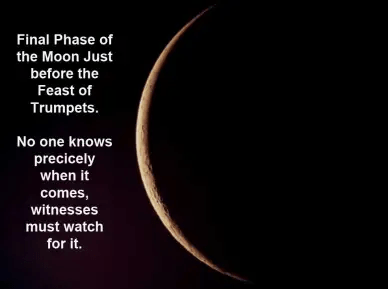
Trumpets is unique when compared to every other Biblical feast in that it is the only divine appointment that is not predetermined and fixed by a set day on the calendar. Yom Teruah begins of the first day of the seventh month (Tishri 1), and the only way to determine the first day of the month is visibly to observe the new moon in the night sky.
Obviously with the advent of modern technology and the accuracy of astronomical algorithms, we can more precisely predict the timing of each new moon; however, in Biblical times, the only way to identify the first of the month was to observe the night sky and watch for the sign of the new moon to emerge. Of course, our ancient ancestors had sufficient knowledge of the heavenly bodies as they followed their courses and would have known when the first day of the month was near — within a day or two. Consequently after their exile in Babylon, the Jewish rabbis dedicated a two-day window for the Feast of Trumpets just to ensure the new moon was accurately sighted.
To learn more about this two day window, read here.
So the official sign of the Feast of Trumpets was the sighting of the new moon, which then followed by a command from the High Priest to begin sounding the trumpet blasts, or shofar, and announce the beginning of the festival. Historically Yom Teruah has been celebrated with shouting, singing, candle lighting, and feasting with joy.
But if Jesus was using His teaching to draw a connection between the Feast of Trumpets and His return, perhaps this holy day — like all appointed feasts — is providing a prophetic shadow picture of the ministry and mission of Jesus.
The Biblical Imagery and Purpose of the Shofar
“God has gone up with a shout, the LORD with the sound of a trumpet. Sing praises to God, sing praises! Sing praises to our King, sing praises! For God is the King of all the earth; sing praises with a psalm!”
[Psalm 47:5-7]
The shofar — or ram’s horn — is a prominent symbol throughout Biblical history.
The trumpet was sounded on Mt. Sinai when the LORD came down in flaming fire to meet with Moses and enter into covenant with Israel (Exodus 19).
The shofar was blown under Joshua’s command during the conquest of Jericho (Joshua 6).
The shofar was sounded by Gideon as he led Israel to defeat the Midianites (Judges 7).
The trumpet was sounded at the coronation or procession of the King (Psalm 47, 98).
The shofar also was blown as a battle cry against the enemies of God.
But beyond all that, the trumpet has always been connected to the return of Christ our King to the earth the judge the living and the dead. Just consider the following verses.
The great day of the LORD is near,near and hastening fast;the sound of the day of the LORD is bitter;the mighty man cries aloud there.A day of wrath is that day,a day of distress and anguish,a day of ruin and devastation,a day of darkness and gloom,a day of clouds and thick darkness, A day of trumpet blast and battle cryagainst the fortified citiesand against the lofty battlements.
[Zephaniah 1:14-16]
Blow a trumpet in Zion; sound an alarm on my holy mountain! Let all the inhabitants of the land tremble, for the day of the LORD is coming; it is near;a day of darkness and gloominess, a day of clouds and thick darkness…
[Joel 2:1]
Then the LORD will appear over them, and his arrow will go forth like lightning; the Lord GOD will sound the trumpet and will march forth in the whirlwinds of the south.
[Zechariah 9:14]
For this we declare to you by a word from the Lord, that we who are alive, who are left until the coming of the Lord, will not precede those who have fallen asleep. For the Lord himself will come down from heaven with a cry of command, with the voice of an archangel, and with the sound of the trumpet of God. And the dead in Christ will rise first. Then we who are alive, who are left, will be caught up together with them in the clouds to meet the Lord in the air, and so we will always be with the Lord. Therefore comfort one another with these words.
[1 Thessalonians 4:15-18]
Behold! I tell you a mystery. We shall not all sleep, but we shall all be changed, in a moment, in the twinkling of an eye, at the last trumpet. For the trumpet will sound, and the dead will be raised imperishable, and we shall be changed.
[1 Corinthians 15:51-52]
Then the seventh angel sounded his trumpet, and loud voices called out in heaven: “The kingdom of the world has become the kingdom of our Lord and of His Christ, and He will reign forever and ever.”
[Revelation 11:15]
As we can clearly see, the blowing of the shofar is a significant and central sign that is connected to the return of Christ. Furthermore, Jesus mentions the blowing of the trump of God in Matthew 24:31 when He says, “And He will send out His angels with a loud trumpet call.”
And let us not forget that Jesus perfectly fulfilled the first four spring feasts during His first coming. He was crucified on Passover, buried on the first day of Unleavened Bread, raised to life on the Day of Firstfruits, and poured out the Holy Spirit on the Day of Pentecost.
It only stands to reason that Jesus will fulfill the fall feasts through His second coming, beginning with the day and hour that no one knows — the Day of Trumpets!
Not only can we know the season of Christ’s return to this earth, He expects us to know. He is telling us to observe the signs, keep watching, stay awake, and lift up our heads for our redemption draws near. Just like with the Feast of Trumpets, we may not know the precise day or hour Christ returns, but we will know when His coming is near, even at the very gates of heaven!
I hope that you will celebrate this amazing feast this year with joy and anticipation of the return of our King and to shout His victory over sin and the grave!
One thought on “Can We Know “the Day or the Hour” of Christ’s Return?”
Anthony WongOctober 3, 2024 / 8:50 am
Thanks of the teaching. Totally agree.
This is statement is very much misunderstood & erroneously taught. In any case, this appointed Feast is one of 3 that is going to be fulfilled when Jesus returns.

 Days of Noah
Thanks of the teaching. Totally agree.
This is statement is very much misunderstood & erroneously taught. In any case, this appointed Feast is one of 3 that is going to be fulfilled when Jesus returns.
LikeLiked by 1 person