Types and Shadows — Trumpets

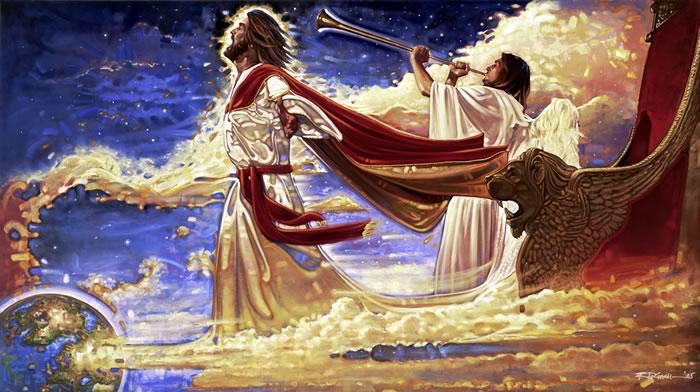
For the Lord himself will descend from heaven with a cry of command, with the voice of an archangel, and with the sound of the trumpet of God. And the dead in Christ will rise first.

1 Thessalonians 4:16

Today at sundown [September 18, 2020] designates the new year on the Jewish civic calendar. This day is called Rosh Hashanah and initiates the two-day Feast of Trumpets.

The Feast of Trumpets is one of the seven appointed Feasts of the LORD, given to the people of Israel to observe faithfully each year as holy convocations [see Leviticus 23]. The Feast of Trumpets is called Yom Teruah — the Day of Shouting — and traditionally is known as the hidden day because it is the only feast day that must be determined by the observation of the new moon.

The Lord Jesus makes a direct reference to this “hidden” day by using a common idiom, “But concerning that day or that hour, no one knows” [Mark 13:32]. As witnesses were told to observe the night sky for the first sighting of the new moon, it was difficult to know the precise day or the hour the moon would appear, and yet they still knew when the day was near. The whole nation would be waiting and watching in quiet expectation of this “sign” in heaven, but once the moon was sighted, the people were to make a collective shout of celebration and begin the trumpet blasts to announce the new year!

The Feast of Trumpets is the first of three fall feasts that constitute the most solemn time of year for the Jewish people. The high holy day of Israel — Yom Kippur — follows 10 days after the Feast of Trumpets. For a more detailed account about the Feast of Trumpets, feel free to read the following posts — PART 1 & PART 2.

The Theophany at Sinai

When the LORD instituted His appointed feasts and commanded Israel to observe them each year, He had a two-fold purpose. First, the LORD wanted His people to always remember and never forget how He redeemed Israel from Egypt with mighty signs and wonders and entered into covenant with them on the holy mountain — Sinai.

Second, the LORD also designed the appointed feasts to be prophetic “dress rehearsals” by establishing patterns and symbolic pictures that provide detailed depictions of the coming Messiah. Once you understand the prophetic significance of these appointed feasts, you will be astonished to discover how intentional and precise God’s word truly is.

When the LORD initiated the Feast of Trumpets with Israel in Leviticus 23, He commanded them to sound the trumpet blast on the first day of the month. The significance of the trumpet blast would have been quite fresh for this original audience because of what Moses and the Israelites had just witnessed at Mount Sinai.

This amazing encounter is worth another look.

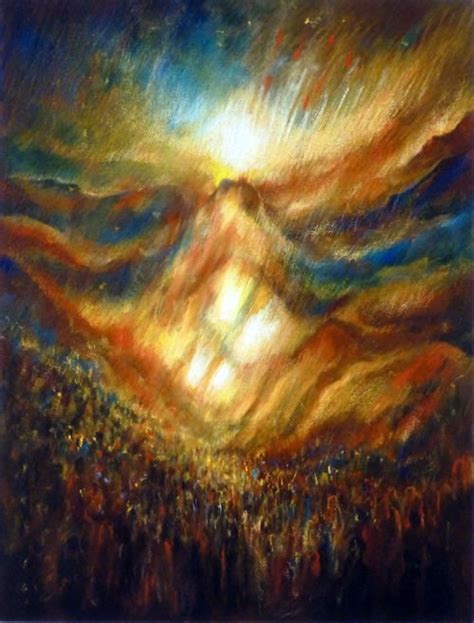
On the morning of the third day there were thunders and lightnings and a thick cloud on the mountain and a very loud trumpet blast, so that all the people in the camp trembled17Then Moses brought the people out of the camp to meet God, and they took their stand at the foot of the mountain. 18Now Mount Sinai was wrapped in smoke because the LORD had descended on it in fire. The smoke of it went up like the smoke of a kiln, and the whole mountain trembled greatly. 19And as the sound of the trumpet grew louder and louder, Moses spoke, and God answered him in thunder. 20The LORD came down on Mount Sinai, to the top of the mountain. And the LORD called Moses to the top of the mountain, and Moses went up.

Exodus 19:16-20

The Feast of Trumpets is a dedicated day to remember the greatest manifestation of God ever witnessed on this earth. The trumpet blast was so intense that the people trembled and feared for their very lives in the presence of the God’s power and glory.

This was the day that the LORD God of Israel “came down” and showed Himself to His people. A day never to forget.

On the other hand, the theophany at Sinai serves as perhaps the most obvious allusion to the second coming of Jesus Christ. Just as the LORD gathered his people and came down on Mount Sinai in a cloud and with fire and lightening and trumpet blasts, so Jesus will return in like manner.

The language of the New Testament draws directly from this event to describe the return of Jesus from heaven to earth.

Immediately after the tribulation of those days the sun will be darkened, and the moon will not give its light, and the stars will fall from heaven, and the powers of the heavens will be shaken. 30Then will appear in heaven the sign of the Son of Man, and then all the tribes of the earth will mourn, and they will see the Son of Man coming on the clouds of heaven with power and great glory. 31And he will send out his angels with a loud trumpet call, and they will gather his elect from the four winds, from one end of heaven to the other.

Matthew 24:29-31

For this we declare to you by a word from the Lord, that we who are alive, who are left until the coming of the Lord, will not precede those who have fallen asleep. 16For the Lord himself will descend from heaven with a cry of command, with the voice of an archangel, and with the sound of the trumpet of God. And the dead in Christ will rise first. 17Then we who are alive, who are left, will be caught up together with them in the clouds to meet the Lord in the air, and so we will always be with the Lord.

1 Thessalonians 4:15-17

The Battle of Jericho

Although there are so many types and shadows I could draw from, I want to close with another fascinating episode involving the trumpet blast — Jericho.

Many of us grew up singing the old Sunday school song, “Joshua fought the battle of Jericho, Jericho, Jericho … and the walls came a tumbling down.” But the truth is that it was the LORD Himself who gave Israel the victory at the stronghold of Jericho, and He did so in a most unconventional way. Once again, what may have seemed like a bizarre command from God at the time was actually another prophetic picture God was painting in real time to point us to the final Day of the LORD!

Let’s take a closer look.

First we can’t overlook the encounter that Joshua has with the LORD just prior to the battle at Jericho. I am persuaded that this was an encounter with God the Son — the Lord Jesus — in a pre-incarnate manifestation [see Colossians 1:15-17].

When Joshua was by Jericho, he lifted up his eyes and looked, and behold, a man was standing before him with his drawn sword in his hand. And Joshua went to him and said to him, “Are you for us, or for our adversaries?” 14And he said, “No; but I am the commander of the army of the LORD. Now I have come.” And Joshua fell on his face to the earth and worshiped and said to him, “What does my lord say to his servant?” 15And the commander of the LORD’s army said to Joshua, “Take off your sandals from your feet, for the place where you are standing is holy.” And Joshua did so.

Joshua 5:13-15

The commander of the LORD’s army is standing with His sword drawn and is clearly God in human form because of Joshua’s response in fear and worship. Now listen to what the LORD told Joshua to do.

And the LORD said to Joshua, “See, I have given Jericho into your hand, with its king and mighty men of valor. 3You shall march around the city, all the men of war going around the city once. Thus shall you do for six days. 4Seven priests shall bear seven trumpets of rams’ horns before the ark. On the seventh day you shall march around the city seven times, and the priests shall blow the trumpets. 5And when they make a long blast with the ram’s horn, when you hear the sound of the trumpet, then all the people shall shout with a great shout, and the wall of the city will fall down flat, and the people shall go up, everyone straight before him.”

Joshua 6:2-5
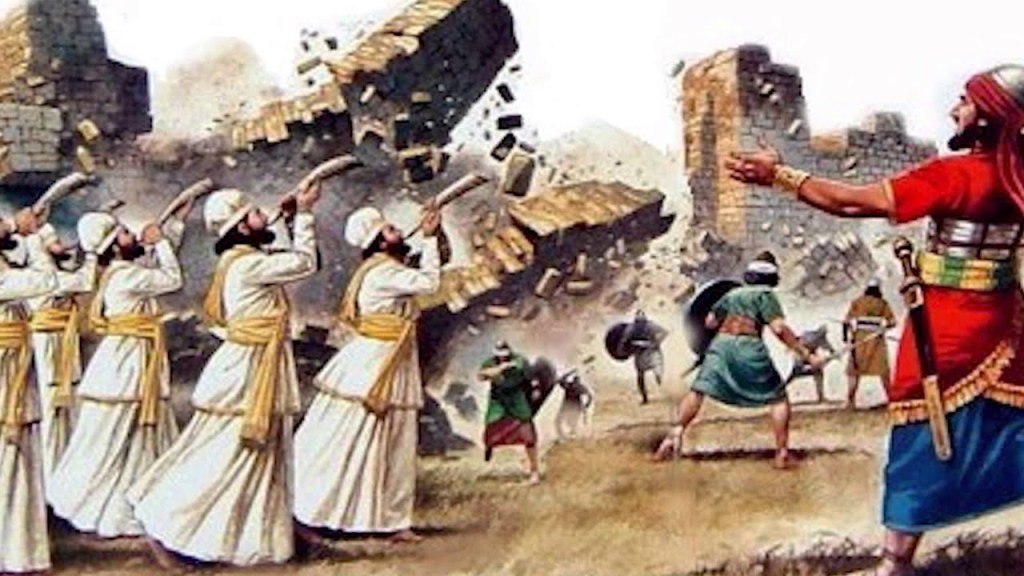
Once again, the theatrics are intentional for prophetic purposes. The LORD was taking Israel through a dress rehearsal that in many ways will mirror the Day of the LORD. The fighting men were commanded to march around the city for 7 days with seven priests leading the way before the ark of the covenant, blowing 7 trumpets. Then they were to march around the city 7 times on the 7th day.

And then upon God’s command the priests were to make a long blast with their shofars and all the people were to give a great shout! Then earth would quake and the walls would crumble and their enemies would be given into their hands for total destruction.

The imagery is astoundingly prophetic. First of all, Joshua is one of the most obvious types of Christ in the Old Testament — even sharing the very same Hebrew name with Yeshua. The symbolism beyond that is simply amazing. Consider …

  • The repeated use of patterns with the number 7
  • The role of the ark of the covenant
  • The sounding of the last trumpet
  • The shouting of the people
  • The walls of the city falling down
  • The wrath of God poured out on His enemies
  • Israel conquering and inheriting the Promise Land

Both the 7th Trumpet and 7th Bowl from the book of Revelation draws directly from this event.

Then the seventh angel blew his trumpet, and there were loud voices in heaven, saying, “The kingdom of the world has become the kingdom of our Lord and of his Christ, and he shall reign forever and ever.” 16And the twenty-four elders who sit on their thrones before God fell on their faces and worshiped God,17saying,

“We give thanks to you, Lord God Almighty,
who is and who was,
for you have taken your great power
and begun to reign.
18The nations raged,
but your wrath came
,
and the time for the dead to be judged,
and for rewarding your servants, the prophets and saints,
and those who fear your name,
both small and great,
and for destroying the destroyers of the earth.”

19Then God’s temple in heaven was opened, and the ark of his covenant was seen within his temple. There were flashes of lightning, rumblings, peals of thunder, an earthquake, and heavy hail.

Revelation 11:15-19

The seventh angel poured out his bowl into the air, and a loud voice came out of the temple, from the throne, saying, “It is done!” 18And there were flashes of lightning, rumblings, peals of thunder, and a great earthquake such as there had never been since man was on the earth, so great was that earthquake. 19The great city was split into three parts, and the cities of the nations fell, and God remembered Babylon the great, to make her drain the cup of the wine of the fury of his wrath.

Revelation 16:17-19

Finally, we know that the Apostle Paul also makes a direct reference to the last trumpet on the last day when Jesus returns.

I tell you this, brothers: flesh and blood cannot inherit the kingdom of God, nor does the perishable inherit the imperishable. 51Behold! I tell you a mystery. We shall not all sleep, but we shall all be changed, 52in a moment, in the twinkling of an eye, at the last trumpet. For the trumpet will sound, and the dead will be raised imperishable, and we shall be changed. 53For this perishable body must put on the imperishable, and this mortal body must put on immortality.

1 Corinthians 15:50-53

So as we recognize and celebrate the Feast of Trumpets this weekend, may we first remember the mighty acts of God on behalf of His people, and may we also wait in hopeful expectation for the coming of our Lord Jesus Christ when the final trumpet blast is sounded!

Maranatha!
The Feast of Tabernacles Future Fulfillment

“And I heard a loud voice from the throne saying, “Behold, the dwelling place of God is with man. He will dwell with them, and they will be his people, and God himself will be with them as their God.”

[Revelation 21:3]

It all started in the Garden. God creating man in His own image. Man dwelling with God in perfect harmony. God made His home with man. Man in right relationship with his Maker. It was paradise.

Then paradise was lost.

Adam and Eve were cast out of the Garden — separated from God. The entire creation was cursed. The consequences of sin and death ensued, and the earth — man’s home — became the devil’s playground.

Ever since man was expelled from the Garden, he has been trying to do one thing — find a way back to God.

That is the essence of the gospel. Man could never make his way back into right relationship with God on his own. Man could never merit the privilege of being allowed back into the presence of a Holy God. That is why God had to initiate the plan of restoration and provide the only way of salvation by coming to us.

When it comes to the final fulfillment of the Feast of Tabernacles, we must be reminded that God’s people are awaiting the Day when the dwelling place [tabernacle] of God will forever be with man!

The Word Become Flesh

The entire gospel story of God’s redemption hinges upon the restoration of God and man through the Person and work of Jesus Christ. As Peter says, “For Christ also suffered once for sins, the righteous for the unrighteous, that he might bring us to God, being put to death in the flesh but made alive in the spirit” [1 Peter 3:18].

The Lord Jesus Christ is the Creator — God the Son — the Word become flesh. The good news is that God, in His love for humanity, chose to leave His position in heaven, temporarily laying aside His divine glory, and came to earth to “tabernacle” among us in human form [see John 1:1-14]. That is why He is Immanuel — God with us — and He came to provide mankind the only way back to God the Father.

“Let not your hearts be troubled. Believe in God; believe also in me. In my Father’s house are many rooms. If it were not so, would I have told you that I go to prepare a place for you? And if I go and prepare a place for you, I will come again and will take you to myself, that where I am you may be also. And you know the way to where I am going.” Thomas said to him, “Lord, we do not know where you are going. How can we know the way?” Jesus said to him, “I am the way, and the truth, and the life. No one comes to the Father except through me.”

[John 14:1-6]

After accomplishing the work of redemption through His death, burial and resurrection, Jesus spent valuable time teaching His disciples about the kingdom of God. Just before ascending to heaven, Jesus promised to tabernacle with His people in a new and living way — through the indwelling presence of the Holy Spirit.

“Do you not know that you are God’s temple and that God’s Spirit dwells in you?”

[1 Corinthians 3:16]

In one very real sense God’s kingdom already has come in the Person and work of Christ, and God’s Spirit dwells within every believer. But in another sense God’s kingdom is not yet because evil remains at work in this world and the restoration of all things is yet future.

So how and when will the Feast of Tabernacles be ultimately fulfilled?

The Second Coming of Christ

Then the seventh angel blew his trumpet, and there were loud voices in heaven, saying, “The kingdom of the world has become the kingdom of our Lord and of his Christ, and he shall reign forever and ever.”

[Revelation 11:15]

If we are following the prophetic timeline that God has established through His appointed Feasts, then we should remember that the first two fall feasts will be fulfilled at second coming of Christ. The Feast of Trumpets will be fulfilled when the last trumpet is sounded and Jesus returns from heaven to earth on the clouds in power and great glory [see Matthew 24:29-31, 1 Thessalonians 4:13-18].

The Day of Atonement will be fulfilled, as all Israel will be saved when Christ returns to punish the enemies of God and trample the Antichrist and his hostile armies surrounding Jerusalem.

Immediately after the Lord Yeshua defeats His enemies and liberates Jerusalem, He will be exalted as King of kings and take His place on David’s throne in Zion to reestablish His Kingdom Israel on earth.

Zechariah provides a glimpse into this awesome Day.

“Behold, a day is coming for the LORD, when the spoil taken from you will be divided in your midst. For I will gather all the nations against Jerusalem to battle, and the city shall be taken and the houses plundered and the women raped. Half of the city shall go out into exile, but the rest of the people shall not be cut off from the city. Then the LORD will go out and fight against those nations as when he fights on a day of battle. On that day his feet shall stand on the Mount of Olives that lies before Jerusalem on the east, and the Mount of Olives shall be split in two from east to west by a very wide valley, so that one half of the Mount shall move northward, and the other half southward. And you shall flee to the valley of my mountains, for the valley of the mountains shall reach to Azal. And you shall flee as you fled from the earthquake in the days of Uzziah king of Judah. Then the LORD my God will come, and all the holy ones with him … And the LORD will be king over all the earth. On that day the LORD will be one and his name one.”

[Zechariah 14:1-6, 9]

Once King Jesus takes His place on the throne, God’s people will be invited to take part in the marriage supper of the Lamb, which will be the great victory banquet on earth celebrating the triumph of the King.

Jesus said … “I tell you I will not drink again of this fruit of the vine until that day when I drink it new with you in my Father’s kingdom.”

[Matthew 26:29]

The Millennial Kingdom and the Feast of Tabernacles

Once Jesus returns to the earth as King, He will rule and reign His Kingdom from Jerusalem, and the saints will rule with Him. Many have called this the Messianic Age, or the Millennial Kingdom of Christ. The Kingdom will be God’s way of bringing paradise back to the earth. God will live in physical, bodily form in the midst of the earth, and we will dwell in the presence of Almighty God.

The Millennium will be a literal 1,000 year period for Christ to reign as King and for God to dwell with man. It will give mankind the privilege to enjoy an age of unprecedented peace, prosperity, knowledge, restoration, longevity, blessing, and beauty.

Interestingly enough, the Feast of Tabernacles will play a prominent role during this unique Messianic Age, as the survivors of the nations will be required to present themselves before the LORD each year to celebrate the Feast of Booths.

Then everyone who survives of all the nations that have come against Jerusalem shall go up year after year to worship the King, the LORD of hosts, and to keep the Feast of Booths. And if any of the families of the earth do not go up to Jerusalem to worship the King, the LORD of hosts, there will be no rain on them. And if the family of Egypt does not go up and present themselves, then on them there shall be no rain; there shall be the plague with which the LORD afflicts the nations that do not go up to keep the Feast of Booths. This shall be the punishment to Egypt and the punishment to all the nations that do not go up to keep the Feast of Booths.

[Zechariah 14:16-19]

The saints of the Most High will rule and reign with King Jesus and the nations will be subject to Him. There are a variety of passages that portray this unique Millennial Kingdom, but for sake of time I will only share one more from the prophet Isaiah.

“It shall come to pass in the latter days
that the mountain of the house of the LORD
shall be established as the highest of the mountains,
and shall be lifted up above the hills;
and all the nations shall flow to it,
and many peoples shall come, and say:
‘Come, let us go up to the mountain of the LORD,
to the house of the God of Jacob,
that he may teach us his ways
and that we may walk in his paths.’
For out of Zion shall go forth the law,
and the word of the LORD from Jerusalem.
He shall judge between the nations,
and shall decide disputes for many peoples;
and they shall beat their swords into plowshares,
and their spears into pruning hooks;
nation shall not lift up sword against nation,
neither shall they learn war anymore.”
[Isaiah 2:2-4]

The New Heaven, Earth and Jerusalem

After the earth is allowed to experience this 1,000 year Sabbath rest of peace under the Lordship of Jesus Christ, the Bible then describes a New Heaven and New Earth, where God makes everything new and dwells with His people forevermore. Everything that was lost in the Garden will be restored and recreated, and there will be no more evil, no more sin, no more death, and no more suffering.

“For behold, I create new heavens and a new earth, and the former things shall not be remembered or come into mind.”

[Isaiah 65:17]

The Apostle John provides even more detail about the eternal state of man and God’s promise to tabernacle with mankind forevermore.

“Then I saw a new heaven and a new earth, for the first heaven and the first earth had passed away, and the sea was no more. And I saw the holy city, new Jerusalem, coming down out of heaven from God, prepared as a bride adorned for her husband. And I heard a loud voice from the throne saying, ‘Behold, the dwelling place of God is with man. He will dwell with them, and they will be his people, and God himself will be with them as their God. He will wipe away every tear from their eyes, and death shall be no more, neither shall there be mourning, nor crying, nor pain anymore, for the former things have passed away.’ And he who was seated on the throne said, ‘Behold, I am making all things new.’ Also he said, ‘Write this down, for these words are trustworthy and true.’ And he said to me, ‘It is done! I am the Alpha and the Omega, the beginning and the end. To the thirsty I will give from the spring of the water of life without payment. The one who conquers will have this heritage, and I will be his God and he will be my son’ … And I saw no temple in the city, for its temple is the Lord God the Almighty and the Lamb. And the city has no need of sun or moon to shine on it, for the glory of God gives it light, and its lamp is the Lamb. By its light will the nations walk, and the kings of the earth will bring their glory into it, and its gates will never be shut by day—and there will be no night there. They will bring into it the glory and the honor of the nations.”

[Revelation 21:1-7, 22-26]
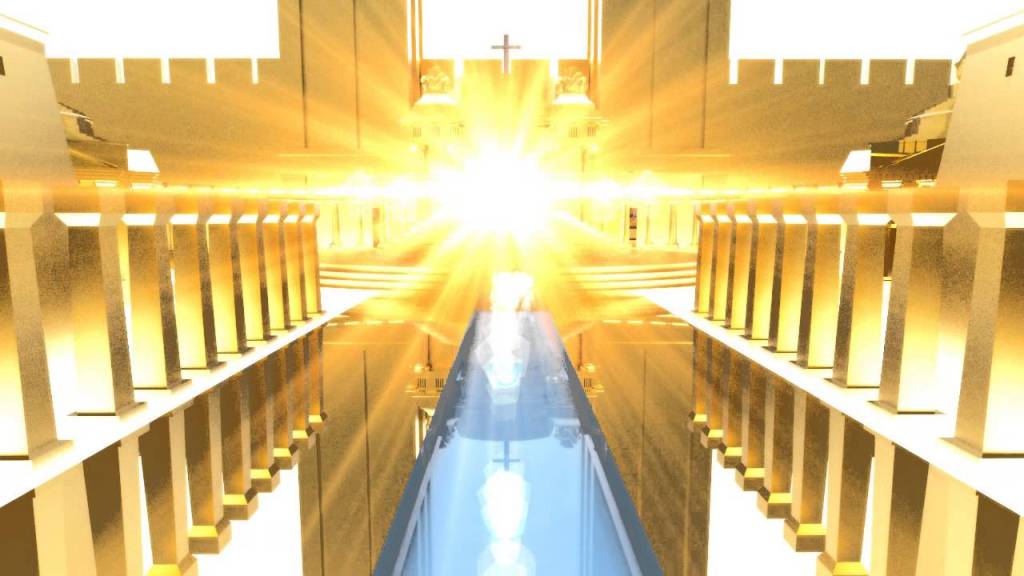
Artistic Rendering of the New Jerusalem

As you can see, the Feast of Tabernacles symbolizes the ongoing, perpetual state of Holy God dwelling with man. Just as God commanded Israel to set aside the 8th Day of rest following the Feast of Booths, He has set aside an eternal 8th Day — the Day of New Beginnings of Recreation — which will be the everlasting life we will experience through and with Christ in the New Heaven and New Earth!

The Feast of Tabernacles – Part 1

And the LORD spoke to Moses, saying, “Speak to the people of Israel, saying, On the fifteenth day of this seventh month and for seven days is the Feast of Booths (Tabernacles) to the LORD … You shall celebrate it as a feast to the LORD for seven days in the year. It is a statute forever throughout your generations; you shall celebrate it in the seventh month. You shall dwell in booths for seven days. All native Israelites shall dwell in booths, that your generations may know that I made the people of Israel dwell in booths when I brought them out of the land of Egypt: I am the LORD your God.”

[Leviticus 23:33-34, 41-43]

The third and final fall feast is the Feast of Tabernacles — or Sukkot in Hebrew. Sukkot is the Hebrew word for booth or temporary shelter, which is why this appointed feast is also called Booths. The Feast of Tabernacles always falls on the 15th day of the seventh month of Tishrei, which is 5 days after the Day of Atonement.

In contrast to the Day of Atonement, which is commemorated with fasting, repentance, and solemn self-examination, Tabernacles is a joyous occasion with feasting, dancing, singing and worshiping the LORD. Tabernacles is to be celebrated for an entire week, followed by a special 8th day solemn day of rest called ‘Shemini Atzeret‘ (the eighth day of assembly). I will discuss the significance of this 8th day in my next post.

Like every other appointed Feast of the LORD, Tabernacles was designed by God to be an annual memorial of the past and a dress rehearsal for the future. It is no surprise that Tabernacles is directly connected to the most important event in Israel’s history — the Exodus.

After Yahweh redeemed the children of Israel from bondage and demonstrated His supreme power over Pharaoh and the gods of Egypt, He led Israel through the Red Sea on their way to the Promised Land. That journey lasted much longer, however, because of the people’s stubborn unbelief, which derailed them into a 40-year wandering in the wilderness.

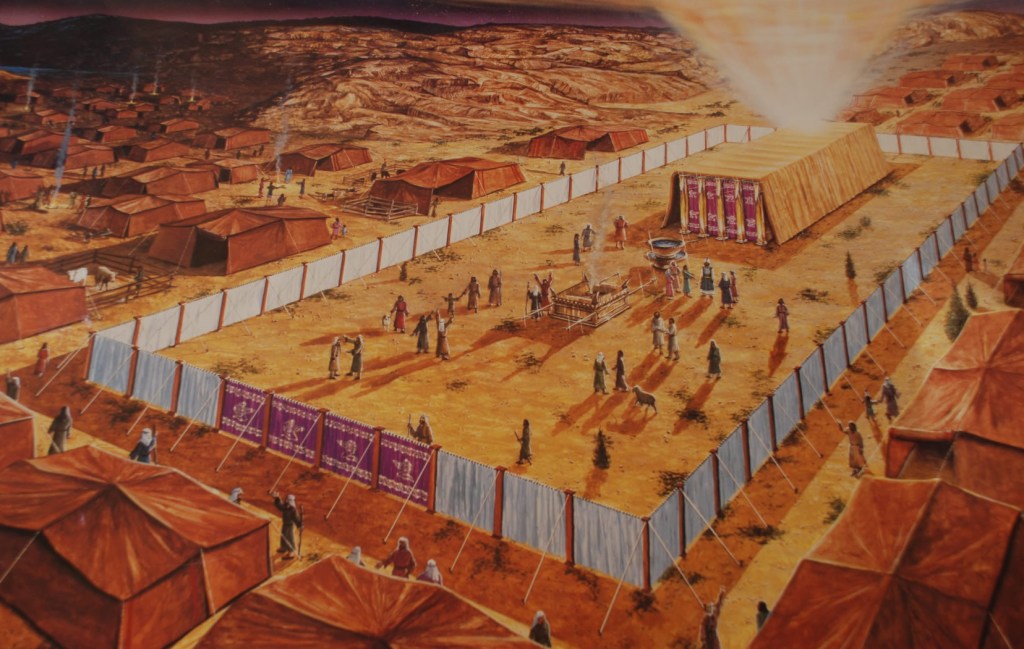
During this wandering, the Israelites were forced to dwell in temporary shelters, or booths. The LORD also instructed Moses to build a Tabernacle for Him — the Tent of Meeting — which always was located in the center of the camp. All 12 tribes of Israel were to remain encamped around the Tabernacle of the LORD.

To remember the Exodus story, the LORD instructed the Israelites to build their own temporary shelters — or booths — and dwell in them for an entire week each year. As you might imagine, this appointed feast also points to a time when the LORD will once again dwell in the midst of His people.

The Tabernacle and the Temple

Once the Israelites settled in the Promised Land and the 12 tribes received their allotted inheritance, the Tabernacle lost some significance in the Biblical narrative. Although the Tabernacle was moved around some, it eventually landed in Shiloh, where a community of priests took care of it’s contents, especially the Ark of the Covenant.

Years later King David established Jerusalem as the capital city of Israel and resolved to bring the Ark of the Covenant to Zion. The Bible says that David erected a replica of the Tabernacle to house the Ark, which the Prophet Amos called the “tent of David” [Amos 9:11].

Although the LORD would not allow David to build Him a permanent dwelling place, David’s son, King Solomon, was chosen by God to build the Temple in Jerusalem. Solomon dedicated the Temple on the 15th of Tishrei — the Feast of Tabernacles — and the Shekinah glory of the LORD filled the Temple [2 Chronicles 7:8-10].

“But will God indeed dwell with man on the earth? Behold, heaven and the highest heaven cannot contain you, how much less this house that I have built! Yet have regard to the prayer of your servant and to his plea, O LORD my God, listening to the cry and to the prayer that your servant prays before you, that your eyes may be open day and night toward this house, the place where you have promised to set your name, that you may listen to the prayer that your servant offers toward this place.”

[2 Chronicles 6:18-20]

Jesus and the Feast of Tabernacles

Although we do not have Biblical clarity on the exact time of the birth of Jesus, I do not believe that December 25 is the best option. If God is true to task with giving prophetic significance to His appointed Feasts, then it would stand to reason that the Lord Jesus likely was born during one of them. The best candidate in my opinion is the Feast of Tabernacles or perhaps Trumpets.

John’s gospel doesn’t begin with the birth of Jesus, yet John does provide the most thorough theological explanation of how God the Son became the Son of Man.

“In the beginning was the Word, and the Word was with God, and the Word was God. He was in the beginning with God. All things were made through him, and without him was not any thing made that was made …

The true light, which gives light to everyone, was coming into the world. He was in the world, and the world was made through him, yet the world did not know him. He came to his own, and his own people did not receive him. But to all who did receive him, who believed in his name, he gave the right to become children of God, who were born, not of blood nor of the will of the flesh nor of the will of man, but of God.

And the Word became flesh and dwelt among us, and we have seen his glory, glory as of the only Son from the Father, full of grace and truth.

[John 1:1-3, 9-14]

Interestingly enough, the Greek word used for “dwelt” here in John 1:14 is skénoó — meaning to dwell as in a tent, encamp, have my tabernacle.

Taking this into consideration, John could be saying that the Son of God literally took on a human tabernacle, or body, on the actual Feast of Tabernacles.

For a more in-depth explanation of this concept, you can read here.

One of the complementary traditions that became associated with this festival was the erection of four massive golden lampstands [50 cubits high] in the Temple Compound to be lit at sundown. The lampstands emitted light all over Jerusalem, which according to the Jewish rabbis, was symbolic of the God’s Shekinah glory that was promised to return to Israel with the coming of the Messiah.

It is interesting that Jesus appeared in Jerusalem during the Feast of Booths and caused great controversy with His teaching [see John 7-8]. With the massive golden lampstands serving as a backdrop, Jesus said, “I am the light of the world. Whoever follows me will never walk in darkness, but will have the light of life” [John 8:12].

Tabernacles in the Future

As we will see next time, the Feast of Tabernacles has prophetic significance that will be realized after the Second Coming of the Lord Jesus! Stay tuned.

The Feast of Yom Kippur {The Day of Atonement} Future Fulfillment

“For the day of vengeance was in my heart, and my year of redemption had come.”

[Isaiah 63:4]

As we discovered in my last post, the Lord Jesus partially fulfilled many of the specific elements of the Day of Atonement during His first coming. Yeshua is our Great High Priest who offered His own life as the atoning sacrifice for our sins and entered the heavenly tabernacle by His own blood, preparing the way for us to approach the throne of God with confidence.

It is Yeshua who now is the Mediator of a new and better covenant in His blood, as He is seated at the right hand of God the Father in the throne room of heaven, making intercession for His people. Yeshua effectively tore the veil that once separated Holy God from sinful man and provided direct access to God for all who believe in Him.

The richness of the redemptive work of Christ is profound, as books could be written about the depth of the atonement.

This post, however, will consider how the Lord Jesus will ultimately fulfill the Day of Atonement during His second coming. I believe you will find these connections just as significant and worthy of our attention.

MOSES and the SINAI CONNECTION

As mentioned in my last post, there is a traditional connection between the Day of Atonement and the Mosaic Covenant at Mount Sinai. Moses ascended the mountain met with the LORD for 40 days on two different occasions. Moses supposedly descended the second time — face a glow — with the tablets of stone on 10th of Tishrei, which is the Day of Atonement.

Keeping these two distinct mountain top events in mind, I do see a connection representative of the two comings of Jesus Christ. The first descent of Moses from the mountain found the nation of Israel rebellious sin and idolatry, which is synonymous with the condition of the Jews when Jesus came the first time.

At the second descent of Moses, the Israelites were not in rebellion, and Moses’ face shone with the glory of God. Moses also brought the instructions for the tabernacle at his second descent, which correlates with the Feast of Tabernacles. This second descent points to the events associated with the glorious coming of Jesus Christ in all His glory, lighting up the sky from east to west!

Interestingly enough, Jesus also experienced His own 40-day mountain experience. After being baptized by John, Jesus spent 40 days of temptation in the mountain wilderness. Immediately after His 40 days of temptation, Jesus retired to Galilee and began teaching in the synagogue of Nazareth, His home town.

Jesus was given the scroll of Isaiah and He read it before the people, saying that He was the fulfillment of that very prophecy [Luke 4:16-30]. But Jesus purposefully stopped reading the prophecy at a specific point.

“The Spirit of the Lord GOD is upon me,
because the LORD has anointed me
to bring good news to the poor;
he has sent me to bind up the brokenhearted,
to proclaim liberty to the captives,
and the opening of the prison to those who are bound;
to proclaim the year of the LORD’s favor,
and the day of vengeance of our God;
to comfort all who mourn
;

[Isaiah 61:1-2]

The Lord Jesus did not keep reading about the day of vengeance on this occasion because He came the first time to offer forgiveness and mercy through His own death on the cross. This dual prophecy in Isaiah contains elements of both His first and second coming, so Jesus was trying to make a point. He came the first time to offer grace. That’s why He stopped reading when He did. The Day of Vengeance is being reserved for His return to the earth.

The DAY

The Day of Atonement — Yom Kippur — is the highest holy day of the year and therefore became known simply as “The Day.” Unlike all the other appointed feasts of the LORD, Yom Kippur is associated with mourning and judgment and affliction and repentance.

“For whoever is not afflicted on that very day shall be cut off from his people. And whoever does any work on that very day, that person I will destroy from among his people.”

[Leviticus 23:29-30]

The future fulfillment of the Day of Atonement is directly connected to great ant terrible “Day of the LORD,” or Judgment Day. It will be both a Day of Vengeance and also a Day of Deliverance.

Vengeance on the Nations

When Yeshua Messiah returns in all His glory, He will judge and repay all of His enemies by treading the winepress of the fury and the wrath of Almighty God. All the nations who align themselves with the satanic forces of darkness and the armies of the Antichrist will be brought to nothing on that Day.

The Day of Vengeance is a Day of blood, and it is Jesus Himself who will be leading this great judgment of the wicked nations who will be united against God in the last days. Consider some of the primary passages that convey this coming “Day!”

Who is this who comes from Edom,
in crimsoned garments from Bozrah,
he who is splendid in his apparel,
marching in the greatness of his strength?
“It is I, speaking in righteousness,
mighty to save.”

Why is your apparel red,
and your garments like his who treads in the winepress?

“I have trodden the winepress alone,
and from the peoples no one was with me;
I trod them in my anger
and trampled them in my wrath;
their lifeblood spattered on my garments,
and stained all my apparel.
For the day of vengeance was in my heart,
and my year of redemption had come.
I looked, but there was no one to help;
I was appalled, but there was no one to uphold;
so my own arm brought me salvation,
and my wrath upheld me.
I trampled down the peoples in my anger;
I made them drunk in my wrath,
and I poured out their lifeblood on the earth.”

[Isaiah 63:1-6]

“Hasten and come,
all you surrounding nations,
and gather yourselves there.
Bring down your warriors, O LORD.
Let the nations stir themselves up
and come up to the Valley of Jehoshaphat;
for there I will sit to judge
all the surrounding nations.

Put in the sickle,
for the harvest is ripe.
Go in, tread,
for the winepress is full.
The vats overflow,
for their evil is great.

Multitudes, multitudes,
in the valley of decision!
For the day of the LORD is near
in the valley of decision.”

[Joel 3:11-14]

The great day of the LORD is near,
near and hastening fast;
the sound of the day of the LORD is bitter;
the mighty man cries aloud there.
A day of wrath is that day,
a day of distress and anguish,
a day of ruin and devastation,
a day of darkness and gloom,
a day of clouds and thick darkness.”

[Zephaniah 1:14-15]

“This is evidence of the righteous judgment of God, that you may be considered worthy of the kingdom of God, for which you are also suffering—since indeed God considers it just to repay with affliction those who afflict you, and to grant relief to you who are afflicted as well as to us, when the Lord Jesus is revealed from heaven with his mighty angels in flaming fire, inflicting vengeance on those who do not know God and on those who do not obey the gospel of our Lord Jesus. They will suffer the punishment of eternal destruction, away from the presence of the Lord and from the glory of his might, when he comes on that day to be glorified in his saints, and to be marveled at among all who have believed, because our testimony to you was believed.”

[2 Thessalonians 1:5-10]

“Then I saw heaven opened, and behold, a white horse! The one sitting on it is called Faithful and True, and in righteousness he judges and makes war. His eyes are like a flame of fire, and on his head are many diadems, and he has a name written that no one knows but himself. He is clothed in a robe dipped in blood, and the name by which he is called is The Word of God. And the armies of heaven, arrayed in fine linen, white and pure, were following him on white horses. From his mouth comes a sharp sword with which to strike down the nations, and he will rule them with a rod of iron. He will tread the winepress of the fury of the wrath of God the Almighty. On his robe and on his thigh he has a name written, King of kings and Lord of lords.”

[Revelation 19:11-16]

To summarize, Jesus is our Faithful High Priest, dressed in fine linen, is coming from heaven to earth in wrath, but as He comes to judge the nations, His pure white vesture is spattered in the blood of His enemies. This is a picture of the high priest entering the Holy of Holies and sprinkling the blood on the altar, which would have spattered on his all white garments.

The Day of Atonement will not be completely fulfilled until the Lord returns on that DAY.

Vengeance on Azazel — the Scapegoat

There is another connection that must be worth mentioning here, and it is associated with the scapegoat that was banished on the Day of Atonement. The Hebrew word for scapegoat is Azazel, which is also associated with the name of the devil himself.

The prophetic shadow picture is that once the guilt of Israel was transferred to Azazel, then he was banished to the wilderness to die, removing the guilt from God’s people. This is connected to God’s final judgment of Satan and the principalities of evil who are forever guilty for introducing sin and rebellion to mankind.

According to the Book of Enoch, Azazel is one of the leaders of the rebellious Watchers in the time preceding Noah’s flood [Genesis 6:1-5]. Azazel taught men the art of warfare and weaponry and revealed to the people the secrets of witchcraft and corrupted their manners, leading them into wickedness and impurity until at last he was bound hand and foot by the archangel Raphael and chained to the rough and jagged rocks of [Ha] Dudael (= Beth Ḥadudo), where he is to abide in utter darkness until the great Day of Judgment, when he will be cast into the fire to be consumed forever.

“The whole earth has been corrupted through the works that were taught by Azazel: to him ascribe all sin.”

[1 Enoch 10:8]

The Bible confirms the Enoch account in 2 Peter and the Epistle of Jude.

“For if God did not spare angels when they sinned, but cast them into hell and committed them to chains of gloomy darkness to be kept until the judgment.”

[2 Peter 2:4]

“The devil who had deceived them was thrown into the lake of fire and sulfur where the beast and the false prophet were, and they will be tormented day and night forever and ever.”

[Revelation 20:10]

The condemnation of the scapegoat, or Azazel, was a reminder to God’s people year after year that the LORD would ultimately judge the devil and the spiritual forces of wickedness on that Day.

Time of Jacob’s Trouble

The day of Atonement is known for ‘the affliction of the soul’. Thus the Israelites would fast on this day and abstain from anointing their body and from cohabitation. The true affliction of the soul will come during the time of Jacob’s Trouble — the Great Tribulation — when God’s people will suffer persecution and affliction at the hands of Antichrist.

“But when you see Jerusalem surrounded by armies, then know that its desolation has come near. Then let those who are in Judea flee to the mountains, and let those who are inside the city depart, and let not those who are out in the country enter it, for these are days of vengeance, to fulfill all that is written.”

[Luke 21:20-22]

Although it is my firm conviction that all the saints (the church) will be present through this Great Tribulation, it will be a unique time of testing and trouble for the Jews. Historically, the Jews have suffered more than any other people group in the world, and the time of Jacob’s trouble will be one final period of testing for the Jews. God, however, will use this great tribulation to bring them to true repentance so that they will never again rebel against the LORD.

“Behold, I am about to make Jerusalem a cup of staggering to all the surrounding peoples. The siege of Jerusalem will also be against Judah. On that day I will make Jerusalem a heavy stone for all the peoples. All who lift it will surely hurt themselves. And all the nations of the earth will gather against it … And I will pour out on the house of David and the inhabitants of Jerusalem a spirit of grace and pleas for mercy, so that, when they look on me, on him whom they have pierced, they shall mourn for him, as one mourns for an only child, and weep bitterly over him, as one weeps over a firstborn.

[Zechariah 12:2-3, 10]

The time of Israel’s affliction will end when all the tribes of the earth see Yeshua coming on the clouds in great glory and realize that they have rejected their own Messiah.

All Israel Will be Saved — National Redemption

The Day Atonement more specifically is associated with the redemption and restoration of the entire nation of Israel. Whereas Passover emphasizes individual salvation, Yom Kippur is the Day of corporate salvation, as the high priest would offer an atoning sacrifice for the sins of all the people.

The future fulfillment of the Day of Atonement will also be a national salvation of all the survivors of Israel. As the Jews endure the Great Tribulation and God begins to bring them repentance through the time of Jacob’s trouble, all of Israel will be saved in the end at the second coming of Christ.

Romans 11, Zechariah 12, Jeremiah 30,

“At that time shall arise Michael, the great prince who has charge of your people. And there shall be a time of trouble, such as never has been since there was a nation till that time. But at that time your people shall be delivered, everyone whose name shall be found written in the book.”

[Daniel 12:1]

Alas! That day is so great, there is none like it; it is a time of distress for Jacob; yet he shall be saved out of it.”

[Jeremiah 30:7]

 “And just as it is appointed for man to die once, and after that comes judgment, so Christ, having been offered once to bear the sins of many, will appear a second time, not to deal with sin but to save those who are eagerly waiting for him.”

[Hebrews 9:27-28]

Lest you be wise in your own sight, I do not want you to be unaware of this mystery, brothers: a partial hardening has come upon Israel, until the fullness of the Gentiles has come in. And in this way all Israel will be saved, as it is written,

“The Deliverer will come from Zion,
he will banish ungodliness from Jacob;
“and this will be my covenant with them
when I take away their sins.”

[Romans 11:25-27]

The Feast of Yom Kippur {The Day of Atonement} – Part 1

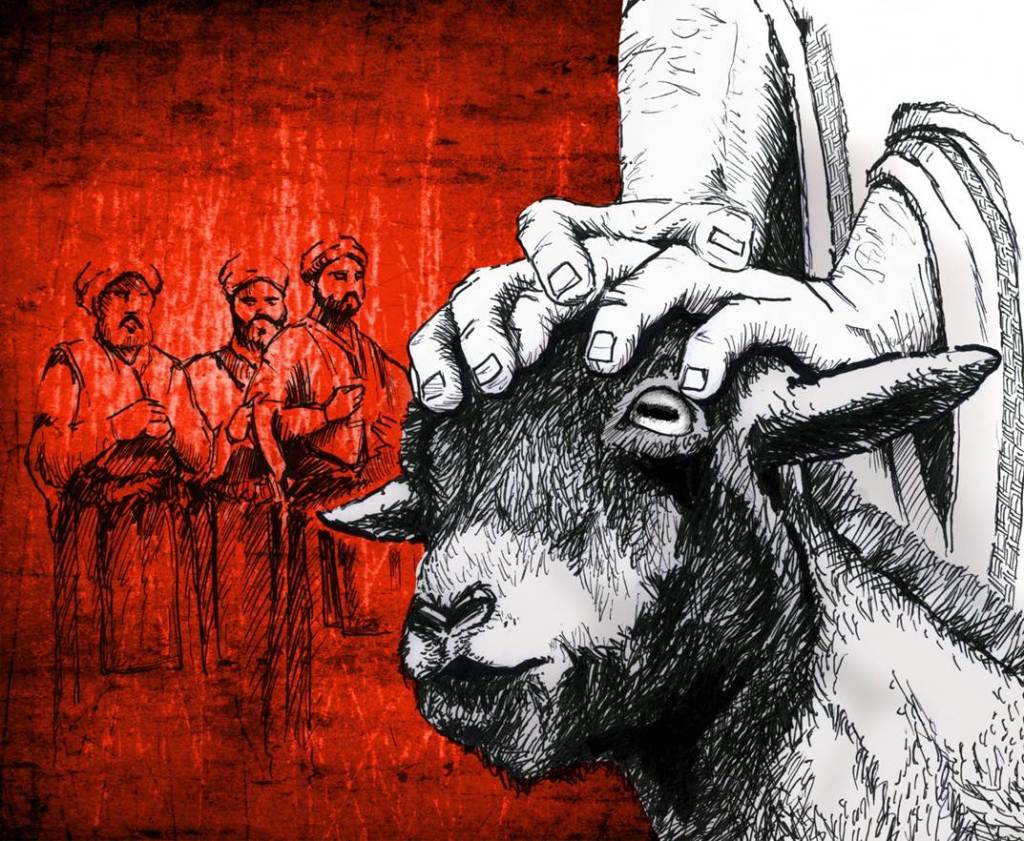
“And Aaron shall lay both his hands on the head of the live goat, and confess over it all the iniquities of the people of Israel, and all their transgressions, all their sins. And he shall put them on the head of the goat and send it away into the wilderness by the hand of a man who is in readiness.”

[Leviticus 16:21]

The Day of Atonement, or Yom Kippur, is the holiest appointed feast of the year for the people of Israel. Once a year, the high priest of Israel was to consecrate himself before the LORD on behalf of the nation by entering the inner sanctuary of the temple and sprinkling blood over the mercy seat of the ark of the covenant. The sins of the entire nation were confessed before God, as the people sought mercy, forgiveness and restoration.

In studying the Day of Atonement, I have come to discover significant connections that are rich with meaning. Once I started pulling on this particular thread, it began to unravel deep prophetic mysteries that I had never seen before.

In short, this holy convocation — or annual rehearsal — provides the most comprehensive typological shadow picture of the Day of the LORD — that great Day of judgment for the whole world.

This initial post will attempt to lay the groundwork and Biblical backdrop of Yom Kippur.

Moses on the Mountain

Once the Feast of Trumpets was announced on Tishrei 1, the LORD instructed the children of Israel to enter into a 10-day period of self examination, fasting, fear, and trembling — called the days of Awe. These 10 days of repentance were to prepare the people of Israel for the Day of Atonement, which was appointed on the 10th of Tishrei.

Jewish tradition historically has associated the 10th of Tishrei as the very day Moses came down from Mount Sinai the second time after spending 40 days mediating between the LORD and the people. God’s anger burned against the children of Israel for their idolatry and rebellion with the golden calf, and Moses knew that something had to be done.

The next day Moses said to the people, “You have sinned a great sin. And now I will go up to the LORD; perhaps I can make atonement for your sin.”

[Exodus 32:30]

When Moses came back down the mountain from having met face to face with the LORD, his face was shining before the people.

“When Moses came down from Mount Sinai, with the two tablets of the testimony in his hand as he came down from the mountain, Moses did not know that the skin of his face shone because he had been talking with God.” [Exodus 34:29]

From that point, Moses primarily would speak with the LORD in the tent of meeting — or tabernacle — and after communicating God’s word to the people with his face aglow, he would place a veil over his face.

The Tabernacle and Holy of Holies

As the children of Israel camped in the wilderness, the LORD instructed Moses to build an intricate tent for His own unique dwelling place in the midst of the people. The tabernacle was called the tent of meeting because it was the one place that the the LORD of glory would visit to meet with Moses.

The tabernacle was divided into three parts, and the inner sanctuary was concealed with a curtain and was the most holy place — the Holy of Holies. The inner sanctuary contained the ark of the covenant [which contained the 10 commandments] and the mercy seat, where the blood from the atoning sacrifice was to be sprinkled on behalf of the people.

Once a year, the high priest would consecrate himself and enter the Holy of Holies wearing only white garments to make atonement for the entire nation. If the high priest failed to approach the LORD in total observance to the law, he would be killed on the spot.

The Scapegoat and the Crimson Cord

The 16th chapter of Leviticus provides the detailed instructions for the Day of Atonement. The high priest was to sacrifice a bull for his own sin before entering the inner sanctuary, and then he was to bring a censor of burnings coals from the altar and incense to cover the mercy seat while applying the blood.

Then the high priest was to take one of two goats and cast lots for them. One goat was to be sacrificed on behalf of the entire nation and the other goat was to be the scapegoat — or  Azazel in Hebrew. The first goat was to be the atoning sacrifice, which temporarily satisfied God’s righteous anger toward the sins of the people. This conveyed the act of propitiation, where a substitute is sacrificed on behalf of another to punish sin and appease the wrath of God.

After making atonement for himself and the people, the high priest then was commanded to place both hands on the scapegoat and confess all the sins of the people over the goat, which effectively transferred the guilt onto the scapegoat and removed the guilt from the people. This conveyed the act of expiation, where guilt is transferred onto another and removed far away from the guilty. The scapegoat was then driven out into the wilderness, where eventually it would be forced off a cliff.

Jewish writings later reveal that the priests would tie a crimson thread both to the scapegoat and the door of the temple in order to determine if the LORD had accepted the sacrifices. If both crimson threads turned white, then the people took that as a sign that the sacrifices had been acceptable in God’s sight.

Interestingly enough, according to the Jerusalem Talmud, during the 40 years between the death of Yeshua and the destruction of the Temple (A.D. 70) the crimson cord never turned white.

“Forty years before the destruction of the Temple, the western light went out, the crimson thread remained crimson, and the lot for the Lord always came up in the left hand. They would close the gates of the Temple by night and get up in the morning and find them wide open.” 

[Jacob Neusner, The Yerushalmi, p.156-157]

Jesus Partial Fulfillment of Yom Kippur

“But when Christ appeared as a high priest of the good things that have come, then through the greater and more perfect tent (not made with hands, that is, not of this creation) he entered once for all into the holy places, not by means of the blood of goats and calves but by means of his own blood, thus securing an eternal redemption … Nor was it to offer himself repeatedly, as the high priest enters the holy places every year with blood not his own, for then he would have had to suffer repeatedly since the foundation of the world. But as it is, he has appeared once for all at the end of the ages to put away sin by the sacrifice of himself.”

[Hebrews 9:11-12, 25-26]

The book of Hebrews elaborates on the role of the high priest and the Day of Atonement, specifically how the Lord Jesus has entered into the very presence of God in heaven by His own blood on our behalf. When Jesus died once and for all as the atoning sacrifice for sin, the veil in the Temple was torn in two from top to bottom, exposing the inner sanctuary. God was communicating a message that sinners now have direct access to the Father through the Son — our Great High Priest.

The Day of Atonement does find its partial fulfillment in the first coming of Christ, as He has made propitiation for our sins and the sins of the whole world. The annual rehearsal on Yom Kippur was merely a shadow picture of the good things to come.

“For since the law has but a shadow of the good things to come instead of the true form of these realities, it can never, by the same sacrifices that are continually offered every year, make perfect those who draw near … Therefore, brothers, since we have confidence to enter the holy places by the blood of Jesus, by the new and living way that he opened for us through the curtain, that is, through his flesh, and since we have a great priest over the house of God, let us draw near with a true heart in full assurance of faith, with our hearts sprinkled clean from an evil conscience and our bodies washed with pure water.

[Hebrews 10:1, 19-22]

The Day of Atonement, however, will not ultimately be fulfilled until Christ comes a second time to bring judgment on His enemies, transfer the guilt of sin upon Azazel (the devil), forgive and save the nation of Israel, and completely pour out his wrath upon the wicked.

“And just as it is appointed for man to die once, and after that comes judgment, so Christ, having been offered once to bear the sins of many, will appear a second time, not to deal with sin but to save those who are eagerly waiting for him … But when Christ had offered for all time a single sacrifice for sins, he sat down at the right hand of God, waiting from that time until his enemies should be made a footstool for his feet.”

[Hebrews 9:27-28, 10:12-13]

Stay tuned for my next post — part 2 of the Day of Atonement.

The Feast of Trumpets Future Fulfillment

Then the seventh angel blew his trumpet, and there were loud voices in heaven, saying, “The kingdom of the world has become the kingdom of our Lord and of his Christ, and he shall reign forever and ever.”

[Revelation 11:15]

In the same way that the Lord Yeshua precisely fulfilled the spring Feasts of the LORD in His first coming, He will fulfill the remaining fall feasts at His second coming. The Lamb of God will return as the King of Glory to crush God’s enemies and establish His Kingdom on earth.

In my trumpets part one post, I discussed how the Israelites were to blow the trumpets on the first day of the seventh month, primarily as an annual reminder of when Yahweh appeared before Moses and the people at Sinai. As we will see, Sinai is the predominant typological event from the Old Testament that corresponds to the return of Christ to the earth. The LORD also prescribed other general occasions for the trumpets to be sounded in Israel — all of which have prophetic significance.

All in all, many of the prophetic passages of Scripture that describe the second coming of Christ and the Day of the LORD intentionally use identical language involving trumpet blasts, angelic battle cries, and loud shouts from heaven. As we will see, this is not by accident.

Old Testament Depictions of the Day of the LORD

Before I get to the obvious New Testament passages that correspond to the future fulfillment of the Feast of Trumpets, I would like to examine a few prophetic passages from the Old Testament. These prophecies are concerning the great Day of the LORD, which always has been connected to the coming of Messiah the King at the end of the age to destroy the enemies of Israel.

“The great day of the LORD is near,
near and hastening fast;
the sound of the day of the LORD is bitter;
the mighty man cries aloud there.
A day of wrath is that day,
a day of distress and anguish,
a day of ruin and devastation,
a day of darkness and gloom,
a day of clouds and thick darkness,
a day of trumpet blast and battle cry
against the fortified cities
and against the lofty battlements.

[Zephaniah 1:14-16]

Blow a trumpet in Zion; sound an alarm on my holy mountain! Let all the inhabitants of the land tremble, for the day of the LORD is coming; it is near.”

[Joel 2:1]

“Then the LORD will appear over them, and his arrow will go forth like lightning; the Lord GOD will sound the trumpet and will march forth in the whirlwinds of the south.

[Zechariah 9:14]

The Prophetic Teachings of Yeshua

Beginning with the prophetic words of Yeshua Himself and working through the Apostles, it becomes very evident that the LORD established the Feast of Trumpets so that His people would rehearse each year the dramatic events of God’s future arrival to Zion. We must not forget that these appointed feasts are “holy convocations,” or practice runs in anticipation for the real thing.

As Jesus taught His disciples the details surrounding His second coming on the Mount of Olives, He used language that would have been very familiar to devout Jews who were anticipating the coming Kingdom of God.

“Immediately after the tribulation of those days the sun will be darkened, and the moon will not give its light, and the stars will fall from heaven, and the powers of the heavens will be shaken. Then will appear in heaven the sign of the Son of Man, and then all the tribes of the earth will mourn, and they will see the Son of Man coming on the clouds of heaven with power and great glory. And he will send out his angels with a loud trumpet call, and they will gather his elect from the four winds, from one end of heaven to the other.”

[Matthew 24:29-31]

The “loud trumpet call” that Jesus referred to would have provoked several images in the minds of the disciples. First, the disciples would have remembered the LORD coming down in power and glory at Sinai. Just as Yahweh descended upon the earth at Sinai in flaming fire and thick clouds with trumpets blasting [Exodus 19], so Yeshua will return to the earth in like manner. Only this time, every eye will see Him coming and all the tribes of the earth will mourn at the sight of the Son of Man [see Revelation 1:7].

The Feast of Trumpets undoubtedly would have been in the minds of the disciples, as they had rehearsed this climatic event every year with the sounding of trumpets and with great shouts of joy in anticipation of the King of Glory. Jesus reinforces the imagery of the Feast of Trumpets by using language that uniquely corresponds to this holy day.

We must remember that the Feast of Trumpets was sometimes called the “Hidden Day” in Israel because it could only be determined by the sighting of the new moon on the first day of the seventh month. As the appointed time drew near, the people of Israel would wait and watch throughout all hours of the night to ensure that they did not miss the appearance, or “sign,” of the new moon.

Because of the uncertainty of when the first sign of the moon would appear, no one in Israel could know or predict the exact “day or the hour” when the Feast of Trumpets would arrive. Only the LORD in heaven had perfect knowledge of the precise day and hour.

Only in light of the Feast of Trumpets do the words of Jesus make sense. Unfortunately, many have misinterpreted His words to imply that the second coming could happen without notice at any moment, but that is NOT what Jesus was communicating at all. As a matter of fact if we read His words carefully, He is teaching the exact opposite.

From the fig tree learn its lesson: as soon as its branch becomes tender and puts out its leaves, you know that summer is near. So also, when you see all these things, you know that he is near, at the very gates

But concerning that day and hour no one knows, not even the angels of heaven, nor the Son, but the Father only …

Therefore, stay awake, for you do not know on what day your Lord is coming. But know this, that if the master of the house had known in what part of the night the thief was coming, he would have stayed awake and would not have let his house be broken into. Therefore you also must be ready, for the Son of Man is coming at an hour you do not expect.

[Matthew 24:32-33, 36, 42-44]

Notice that Jesus, using the exact “Feast of Trumpets” language, is teaching His followers to be watchful, ready, and prepared for His return. He clearly says that those paying attention will be able to recognize the signs leading up to His return and therefore will know when His second coming is near, “even at the very gates.”

Like the anticipation of the new moon appearing on the horizon, we are to wait and watch for the appearance of His coming. We may not know the exact hour or even the day, but WE WILL KNOW WHEN HIS RETURN IS CLOSE AT HAND! If we are willing to stay awake and pay careful attention to the signs, we will not be caught sleeping like the rest of the world in darkness, but we will be prepared to meet Jesus in hopeful expectation.

The Prophetic Teachings of Paul

The Apostle Paul builds on the teachings of Jesus and uses the same language to describe the “glorious appearing of our Great God and Savior Jesus Christ” [Titus 2:13]. As you will see, the trumpets again play a prominent role in Paul’s prophecies.

“For as by a man came death, by a man has come also the resurrection of the dead. For as in Adam all die, so also in Christ shall all be made alive. But each in his own order: Christ the firstfruits, then at his coming those who belong to Christ. Then comes the end, when he delivers the kingdom to God the Father after destroying every rule and every authority and power … I tell you this, brothers: flesh and blood cannot inherit the kingdom of God, nor does the perishable inherit the imperishable. Behold! I tell you a mystery. We shall not all sleep, but we shall all be changed, in a moment, in the twinkling of an eye, at the last trumpet. For the trumpet will sound, and the dead will be raised imperishable, and we shall be changed.”

[1 Corinthians 15:21-24, 50-52]

Immediately one can see that Paul is connecting the coming of the Lord with the “last trumpet“, which was the longest and loudest trumpet blast during the culmination of the Feast of Trumpets. Paul also corresponds the sounding of the last trumpet with three simultaneous events.

  1. The Return of Jesus at the end of the age
  2. The Resurrection of the righteous
  3. The Rapture of the church

Paul provides even more detail in his letter to the Thessalonians.

“But we do not want you to be uninformed, brothers, about those who are asleep, that you may not grieve as others do who have no hope. For since we believe that Jesus died and rose again, even so, through Jesus, God will bring with him those who have fallen asleep. For this we declare to you by a word from the Lord, that we who are alive, who are left until the coming of the Lord, will not precede those who have fallen asleep. For the Lord himself will descend from heaven with a cry of command, with the voice of an archangel, and with the sound of the trumpet of God. And the dead in Christ will rise first. Then we who are alive, who are left, will be caught up together with them in the clouds to meet the Lord in the air, and so we will always be with the Lord. Therefore encourage one another with these words.”

[1 Thessalonians 4:13-18]

Again, Paul’s language draws on two primary sources — Moses and Jesus. This description is almost identical both to the appearance of Yahweh on Mount Sinai and to the words of Jesus on the Mount of Olives. Paul is prophetically illustration the events surrounding the second coming of the Lord.

Like at Sinai, the Lord will descend from heaven in a cloud and flaming fire [see 2 Thessalonians 1:8] with the battle cries and shouts from heaven and the blast of the trumpet of God! He is coming back to the earth in the same way He left [Acts 1:11].

Paul also draws from the language of Jesus, who described the great gathering together of His elect from all over the earth at His return [Matthew 24:31]. Just like the trumpet blasts were to summon the children of Israel to gather together before the LORD, we too will be caught up together at the last trump to meet King Jesus as He is descending to the earth in power and great glory. Here again we see the trumpet of God connected to the simultaneous Return of Christ, Resurrection of the dead and Rapture of the church.

The Revelation of Jesus Christ

So much more could be said about the future fulfillment of the Feast of Trumpets and the Return of Jesus Christ. But for the sake of time, I would like to at least mention the testimony of Jesus to the Apostle John concerning the final apocalypse — or revelation — of the Lord.

The Revelation of Jesus Christ remains one of the most mysterious and misinterpreted books in all of holy Scripture. I do believe that the key to understanding Revelation is to read the 7 seals, trumpets and bowls — not in strict chronological order — but rather as partially overlapping and culminating together at the coming of Jesus and the battle of Armageddon.

For example, the 6-7th seals, 7th trumpet and 7th bowl all are describing the same event — the return of King Jesus. All three culminate with similar Sinai language as well, further validating that they are referring to the same event.

  • 7th Seal — “there were peals of thunder, rumblings, flashes of lightning, and an earthquake” [Revelation 8:5]
  • 7th Trumpet (Last Trump) — “there were flashes of lightning, rumblings, peals of thunder, an earthquake, and heavy hail” [Revelation 11:19]
  • 7th Bowl — “The seventh angel poured out his bowl into the air, and a loud voice came out of the temple, from the throne, saying, “It is done!” And there were flashes of lightning, rumblings, peals of thunder, and a great earthquake such as there had never been since man was on the earth, so great was that earthquake” [Revelation 16:17-18]

It only makes sense to harmonize the overlapping descriptions and understand them as the same event. There is only one second coming of Jesus Christ to earth — not multiple, but there are at least five different descriptions of the return of Jesus in the book of Revelation [Revelation 6:12-17, Rev 11:15-19, Rev 14:14-20, Rev 16:15-21, Rev 19:11-21].

Obviously Jesus doesn’t return five separate times! These are all depicting the same event from different perspectives. For the sake of our study today, let’s finish by looking at the 7th Trumpet, or Last Trump, in Revelation 11.

At the blowing of the 7th Trumpet, the kingdoms of the earth become the kingdom of Christ, as He begins to reign. The Lord pours out his final judgement in wrath upon His enemies and rewards the saints who are to inherit the kingdom.

Then the seventh angel blew his trumpet, and there were loud voices in heaven, saying, “The kingdom of the world has become the kingdom of our Lord and of his Christ, and he shall reign forever and ever.” And the twenty-four elders who sit on their thrones before God fell on their faces and worshiped God, saying,

“We give thanks to you, Lord God Almighty, who is and who was, for you have taken your great power and begun to reign. The nations raged, but your wrath came, and the time for the dead to be judged, and for rewarding your servants, the prophets and saints, and those who fear your name, both small and great, and for destroying the destroyers of the earth.” Then God’s temple in heaven was opened, and the ark of his covenant was seen within his temple. There were flashes of lightning, rumblings, peals of thunder, an earthquake, and heavy hail.

[Revelation 11:15-19]

The Feast of Trumpets — Part 1

And the LORD spoke to Moses, saying, “Speak to the people of Israel, saying, In the seventh month, on the first day of the month, you shall observe a day of solemn rest, a memorial proclaimed with blast of trumpets, a holy convocation.”

[Leviticus 23:23-24]

Having rediscovered the prophetic purposes of the spring Feasts of the LORD and the precision with which Christ has fulfilled them in His first coming, I now will turn my attention to the three remaining fall feasts. Although some authors have proposed a correlation between the fall feasts and the first coming of Christ [i.e. Yeshua most likely was born on or around the Feast of Tabernacles], my focus here will remain on the future fulfillment of the fall feasts in connection to His second coming.

The first of the fall feasts traditionally is known as Yom Teruah — the Day of Shouting. The Hebrew word, teruah, is associated with sounding an alarm, shouting the battle cry, making an announcement, and blowing the trumpets. The LORD declared the Feast of Trumpets to begin at the first sighting of the new moon on the seventh month, which means that the appointed time of this feast is unique from all other Feasts of the LORD.

Whereas all other feasts are designated on specific days of the Hebrew calendar, no one precisely knows “the day or the hour” of the Feast of Trumpets because it is determined each year by the appearance of the new moon. As the sixth month draws to a close, the people must wait and watch vigilantly in anticipation for the first sign of the moon’s sliver. Because of the uncertainty of knowing the “day or hour,” Yom Teruah traditionally became a two-day feast to ensure that the people did not miss it.

Once the new moon was sighted, the heralds were to report to the high priest, who validated the sighting on the testimony of two witnesses. Once validated, the high priest commanded the blowing of the shofar from the Temple Mount, which initiated a series of trumpet blasts and celebrations of shouting and praising God throughout the land of Israel. The longest and strongest trumpet blast finally would bring it all to a close, which was the “last trump.”

The LORD commanded His people to observe a special Sabbath, a solemn rest, on this holy day, specifically as a reminder of the greatest day in Israel’s history. The Feast of Trumpets was established as an annual memorial commemorating the day when the LORD descended from heaven in flaming fire onto the top of Mount Sinai to reveal Himself in glory to Moses and His people.

A Memorial for Sinai

The Feast of Trumpets corresponds to the greatest theophany, or divine appearance, that mankind had ever seen. It was at the base of Mount Sinai in the desert of Northwest Arabia that the God of Abraham, Isaac, and Jacob was made manifest in power and great glory before the children of Israel. His presence at Sinai was so awesome to behold that the people begged of Moses, “You speak to us, and we will listen; but do not let God speak to us, lest we die” [Exodus 20:19].

The blowing of trumpets were to serve as a reminder of that most unique and unforgettable day. Let’s take another look at the Biblical account of God’s appearance at Sinai.

 “On the morning of the third day there were thunders and lightnings and a thick cloud on the mountain and a very loud trumpet blast, so that all the people in the camp trembled. Then Moses brought the people out of the camp to meet God, and they took their stand at the foot of the mountain. Now Mount Sinai was wrapped in smoke because the LORD had descended on it in fire. The smoke of it went up like the smoke of a kiln, and the whole mountain trembled greatly. And as the sound of the trumpet grew louder and louder, Moses spoke, and God answered him in thunder. The LORD came down on Mount Sinai, to the top of the mountain. And the LORD called Moses to the top of the mountain, and Moses went up.”

[Exodus 19:16-20]

Notice that these trumpets blasts were of divine origin, sounding from heaven, to announce the coming of the LORD to the earth to meet with His people. The trumpet blasts grew more intense the closer God’s appearance became, causing the people to fear and tremble at His sight.

While the theophany at Sinai remains to be the primary event in connection to the Feast of Trumpets, other purposes later were prescribed for trumpets, all of which are interesting in their own right. As you will see, the blowing of trumpets retains significant purpose in Israel’s past and also prophetic fulfillment in the days to come.

The Silver Trumpets and the Shofar

In Numbers chapter 10 the LORD commanded Moses to fashion two silver trumpets for multiple purposes.

The LORD spoke to Moses, saying, “Make two silver trumpets. Of hammered work you shall make them, and you shall use them for summoning the congregation and for breaking camp … And the sons of Aaron, the priests, shall blow the trumpets. The trumpets shall be to you for a perpetual statute throughout your generations. 

And when you go to war in your land against the adversary who oppresses you, then you shall sound an alarm with the trumpets, that you may be remembered before the LORD your God, and you shall be saved from your enemies. On the day of your gladness also, and at your appointed feasts and at the beginnings of your months, you shall blow the trumpets over your burnt offerings and over the sacrifices of your peace offerings. They shall be a reminder of you before your God: I am the LORD your God.”

[Numbers 10:1-2, 8-10]

Numbers 10 provides the context for how trumpets were to be used among the children of Israel. Trumpets were to be sounded …

  1. To summon and gather God’s people together and also for breaking camp.
  2. For important public announcements (literally evangelism).
  3. To sound the alarm, or battle cry, for war.
  4. To summon God’s presence and power for battle to overcome the enemy.
  5. To initiate the joyous celebrations associated with the appointed feasts and new moon festivals.

Beyond the silver trumpets, the LORD also commanded Israel to use the shofar — or ram’s horn — in similar ways. Perhaps the most famous use of the shofar was during Joshua’s battle at Jericho.

“Have seven priests carry seven rams’ horns in front of the ark. Then on the seventh day, march around the city seven times, while the priests blow the horns. And when there is a long blast of the ram’s horn and you hear its sound, have all the people give a mighty shout. Then the wall of the city will collapse, and the people will go up, each man straight ahead.”

[Joshua 6:4-5]

Other Days Associated with Trumpets

Beyond Sinai, the silver trumpets and shofars, other days traditionally are recognized by the Jews to correspond with the Feast of Trumpets. It is noteworthy to list them here.

  • The Head of the Year — Rosh Hashanah — The Feast of Trumpets announces the beginning of a new year on the Jewish civil calendar.
  • The Day of the Resurrection — The Feast of Trumpets is associated with the day of the awakening blast, as Isaiah says, “Your dead will live; Their corpses will rise. You who lie in the dust, awake and shout for joy …” [Isaiah 26:19].
  • The Day of Judgment — Yom Hadin — Jewish tradition says that the Feast of Trumpets also will be the day the books are opened judgment is rendered prior to the age of the Messianic Kingdom.
  • Day of Coronation of the King — Yom Hamelech – The trumpets were to be sounded at the coronation ceremony of a new king, as we read, “There Zadok the priest took the horn of oil from the tent and anointed Solomon. Then they blew the trumpet, and all the people said, ‘Long live King Solomon!‘” [1 Kings 1:39]

As we will see next time, when one understands the purpose of the Feast of Trumpets in Israel’s past, he will be more likely to understand the greater fulfillment of this fascinating feast in the future, when the Lord Jesus returns in all His glory. The Feast of Trumpets will initiate the Day of the LORD — that great and dreadful Day — when the King returns home to claim what is rightfully His!

“Blow a trumpet in Zion;

sound an alarm on my holy mountain!

Let all the inhabitants of the land tremble,

for the day of the LORD is coming; it is near!”

[Joel 2:1-2]

The Summer Season and the Fullness of the Gentiles

“And when you reap the harvest of your land, you shall not reap your field right up to its edge, nor shall you gather the gleanings after your harvest. You shall leave them for the poor and for the sojourner: I am the LORD your God.”

[Leviticus 23:22]

Autumn has always been my favorite season. Summers in the south can be brutal and unrelenting. It’s not unusual for us to have oppressive heat well into October, so when the cooler temperatures finally began to arrive recently, I gladly grabbed a jacket and embraced the fresh fall air with enthusiasm.

My point is that the long, hot days of summer can wear you down and make you lazy, but the reality is that the summer provides the best opportunity to work, be active and productive. Long days mean more daylight hours to get the job done. A summer wasted is a terrible thing. Seems like I remember the Lord Yeshua having something to say about that.

“We must work the works of him who sent me while it is day; night is coming, when no one can work. As long as I am in the world, I am the light of the world.”

[John 9:4-5]

As I have been studying the seven appointed Feasts of the LORD, I have rediscovered the rich theological and prophetic implications of God’s reckoning of time. God never wastes a season, especially the summer season, and that is precisely where we are on His prophetic timeline.

The LORD’s appointed “moedim” are divided up into four spring and three fall feasts. We already have seen how the Lord Yeshua has fulfilled the spring feasts in His first advent, as the Lamb of God and firstfruits of the resurrection. We will soon see how Christ fulfills the autumn feasts at His second coming.

But what is God doing in between the spring and fall — between the first and second coming of Christ?

How should we understand this long, hard “summer season” that has lasted nearly 2,000 years since the Lord’s first coming? How much longer will the Lord tarry during this summer season and for what primary purpose?

I believe the answer is found in one of the great mysteries of God’s redemptive plan — the fullness of the Gentiles.

The Good News of Gleaning the Fields

Leviticus 23:22 is the pivotal verse in this important chapter. The instructions in this verse can be easily overlooked, but make no mistake, these instructions are tucked neatly between the description of the spring and fall feasts on purpose.

The LORD commanded the Israelites to intentionally leave the edges of their fields untouched each harvest to provide gleanings for the poor and the sojourner (i.e. Gentiles). These gleanings would provide essential sustenance for those who had not inherited land or who were outside the commonwealth of Israel.

Beyond the practical purpose of showing God’s love and concern for the poor and the stranger, the gleanings of the harvest symbolized a much greater spiritual principle — the LORD’s redemptive plan has always included provision for the Gentiles. Israel was strategically placed in the midst of the pagan nations in order to be a light to the Gentiles and a blessing to all the families of the earth (Acts 13:47).

There is perhaps no greater Old Testament picture of this promise than in the story of Ruth and Boaz, the kinsman-redeemer. As Ruth, a poor Moabite widow, was allowed to pick the gleanings from the fields of Boaz, the God or Israel was showing her grace and preparing her to become the Gentile bride of her Jewish kinsman-redeemer. What a typological picture of a predominately Gentile church becoming the bride of Israel’s Redeemer! Wow!

My point is that the summer gleanings in the fields of Israel represent the spiritual summer season in God’s mysterious work of redemption, as He has extended the good news of His grace to the Gentiles for the last 2,000 years!

The spring feasts are fulfilled. The fall feasts will be fulfilled at the appointed time, but at this moment and in this season, God is making provision for the nations to receive salvation through Jesus Christ and become heirs along with Israel, until the fullness of the Gentiles has come in!

“This mystery is that the Gentiles are fellow heirs, members of the same body, and partakers of the promise in Christ Jesus through the gospel.”

[Ephesians 3:6]

Salvation is to the Jew First

“For I am not ashamed of the gospel, for it is the power of God for salvation to everyone who believes, to the Jew first and also to the Greek.”

[Romans 1:16]

To say that the nation and people of Israel have a unique place in relationship to Almighty God may be the understatement of all time. As the LORD chose Abraham, Isaac and Jacob and called them into covenant relationship with Himself, He was beginning the process of creating a new nation – a people for His own possession and purpose.

So it goes without saying that the people and nation of Israel — known today as the Jews — have a special place in God’s sight, as the apple of God’s eye. Perhaps the Apostle Paul says it best when he writes, “Then what advantage has the Jew? Or what is the value of circumcision? Much in every way. To begin with, the Jews were entrusted with the oracles of God” [Romans 3:1-2].

Every single book written in our Bible (with the exception perhaps of Luke and Acts) was inspired through the Holy Spirit and penned by a Jewish author. The word of God has been written and preserved by the Jewish people. It both was to and through the Jews that salvation has come to the world through Yeshua the Messiah.

“They are Israelites, and to them belong the adoption, the glory, the covenants, the giving of the law, the worship, and the promises. To them belong the patriarchs, and from their race, according to the flesh, is the Christ, who is God over all, blessed forever. Amen.”

[Romans 9:4-5]

This is why we should have expected the early New Testament church to consist exclusively of Jewish believers! The Feast of Pentecost was the fulfillment of the firstfruits of the spiritual harvest of God’s people.

But God’s plan of salvation did not stop there. Many of the Jewish believers in Yeshua were too short sighted when considering the overall redemptive work of God. Many of the Jews had forgotten God’s promise to bless all nations of the earth through their Messiah.

After Pentecost was fulfilled through the sending of the Holy Spirit and the salvation of 3,000 Jews from the diaspora, the last days had arrived. Summer had started. But few could comprehend just how long this summer season of God’s patience and grace would last.

A Partial Hardening upon Israel

“Lest you be wise in your own sight, I do not want you to be unaware of this mystery, brothers: a partial hardening has come upon Israel, until the fullness of the Gentiles has come in.”

[Romans 11:25]

Although salvation most certainly came to the Jews first, as a believing Jewish remnant embraced Yeshua as Messiah, the overwhelming majority of the Jewish nation and its leaders rejected their own Messiah and persecuted the early church. Unfortunately, many Gentiles in the church later perverted this reality to develop anti-Semitic, replacement theology that led to atrocious persecution of the Jewish people by “Christians” in the name of Jesus Christ.

This terrible anti-Semitic blight in church history must be acknowledged and condemned, especially considering that the same anti-Semitic spirit is alive and well within Christendom today. Despite the fact that the God’s redemptive work has predominately targeted the Gentile nations for the past 2,000 years, we cannot forget that His promises to redeem and restore the people and nation of Israel still stand today!

The Apostles were clear that the leaders of national Israel were responsible for willingly rejecting Yeshua the Messiah and in that regard were guilty before God for their rebellion. Consider these verses accusing the Jews of rejecting Christ.

“He came to his own, and his own people did not receive him.” 

[John 1:11]

“This Jesus, delivered up according to the definite plan and foreknowledge of God, you crucified and killed by the hands of lawless men.”

[Acts 2:23]

“The God of Abraham, the God of Isaac, and the God of Jacob, the God of our fathers, glorified his servant Jesus, whom you delivered over and denied in the presence of Pilate, when he had decided to release him

[Acts 3:13]

“The God of our fathers raised Jesus, whom you killed by hanging him on a tree.”

[Acts 5:30]

Beyond the initial rejection of Jesus by His own people, the Apostles were relentlessly attacked, persecuted and opposed by the Jewish leaders of their day. The Apostle Paul especially suffered many attacks by the Jews and although forever burdened for his kinsmen in the flesh, he was called to be an Apostle to the Gentiles.

But when the Jews saw the crowds, they were filled with jealousy, and they blasphemously contradicted what Paul was saying. Then Paul and Barnabas answered them boldly: “It was necessary to speak the word of God to you first. But since you reject it and do not consider yourselves worthy of eternal life, we now turn to the Gentiles.”

[Acts 13:45-46]

As Paul writes to the believers in Rome, however, he clarifies that this hardening and jealousy of the Jewish people toward Gentile believers is only temporary in nature. In other words, even though the majority of Jewish people historically have rejected their own Messiah, the LORD has not completely rejected His people the Jews. He has always preserved a believing remnant of the Jewish people to this day.

“I ask then, did God reject His people? Certainly not! … In the same way, at the present time there is a remnant chosen by grace.

[Romans 11:1,5]

The Fullness of the Gentiles and the Future Salvation of Israel

So why such a long “summer” between the first and second coming of the Lord Jesus? In short the answer is simple — Grace. As Peter reminds us, the only reason the Lord tarries is because He is demonstrating patience and mercy to the world in order to allow for as many as possible to be saved before the day of judgment arrives.

“But do not overlook this one fact, beloved, that with the Lord one day is as a thousand years, and a thousand years as one day. The Lord is not slow to fulfill his promise as some count slowness, but is patient toward you, not wishing that any should perish, but that all should reach repentance. But the day of the Lord will come like a thief …”

[2 Peter 3:8-10]

This age of grace, this summer season of God’s mercy, is allowing the fullness of the Gentiles to come into the Kingdom. The LORD promised Abraham that all the nations of the earth would be blessed through him and his offspring (Jesus), which is precisely why Jesus commanded His disciples to go to ends of the earth and make disciples of all nations.

But there is coming a day, much sooner than later, when the fullness of the Gentiles will come to a close, the summer days of grace will end, the great tribulation will begin, God will return special attention to the Jews, and the Day of the LORD will come.

I would like to leave you with some Scriptures that demonstrate how all of this will transpire at the end of the age.

But when you see Jerusalem surrounded by armies, then know that its desolation has come near. Then let those who are in Judea flee to the mountains, and let those who are inside the city depart, and let not those who are out in the country enter it, for these are days of vengeance, to fulfill all that is written. Alas for women who are pregnant and for those who are nursing infants in those days! For there will be great distress upon the earth and wrath against this people. They will fall by the edge of the sword and be led captive among all nations, and Jerusalem will be trampled underfoot by the Gentiles, until the times of the Gentiles are fulfilled.

[Luke 21:20-24]

Then I was given a measuring rod like a staff, and I was told, “Rise and measure the temple of God and the altar and those who worship there, but do not measure the court outside the temple; leave that out, for it is given over to the nations, and they will trample the holy city for forty-two months.” 

[Revelation 11:1-2]

Alas! That day is so great there is none like it; it is a time of distress for Jacob; yet he shall be saved out of it.

[Jeremiah 30:7]

““Behold, I am about to make Jerusalem a cup of staggering to all the surrounding peoples. The siege of Jerusalem will also be against Judah. On that day I will make Jerusalem a heavy stone for all the peoples. All who lift it will surely hurt themselves. And all the nations of the earth will gather against it … And on that day I will seek to destroy all the nations that come against Jerusalem. And I will pour out on the house of David and the inhabitants of Jerusalem a spirit of grace and pleas for mercy, so that, when they look on me, on him whom they have pierced, they shall mourn for him, as one mourns for an only child, and weep bitterly over him, as one weeps over a firstborn.

[Zechariah 12:2-3, 9-10]

And in this way all Israel will be saved, as it is written,

The Deliverer will come from Zion,
he will banish ungodliness from Jacob;
and this will be my covenant with them
when I take away their sins.”

[Romans 11:26-27]

Summer is almost over. The fulfillment of the fall feasts of the LORD are ever so near. Stay tuned as I will examine the fall feasts next time.

The Feast of Weeks {Pentecost} Fulfilled

“When the day of Pentecost arrived, they were all together in one place … And they were all filled with the Holy Spirit and began to speak in other tongues as the Spirit gave them utterance.”

[Acts 2:1,4]

After the Lord Jesus — our Passover Lamb — was crucified, buried and triumphantly resurrected as the Firstfruits from the dead, the Bible says that He “presented himself alive to them after his suffering by many proofs, appearing to them during forty days and speaking about the kingdom of God” [Acts 1:3].

Just before His ascension, Yeshua commanded His disciples to stay in Jerusalem and wait for the promise of the Holy Spirit who would come “not many days from now” [Acts 1:4]. As the disciples gathered in Jerusalem for the Feast of Weeks, or Pentecost, there must have been a spirit of enthusiasm and anticipation for what would happen next. The purpose of Pentecost was about to be fulfilled.

God’s Presence and Power on Display

As I mentioned in my last post, there are obvious parallels between the giving of the law at Sinai and the giving of the Holy Spirit at Pentecost that we cannot overlook.

The LORD commanded Moses to gather all of Israel in one place and to have them consecrate themselves before entering His presence at Sinai. At the appointed time, the people of Israel witnessed perhaps the greatest manifestation of God the world has ever seen.

The theophany at Sinai was as terrifying as it was awesome to behold. The people heard thunderings and trumpet blasts, saw lightening flashes and a thick cloud cover the mountain, and finally the LORD Himself descended in fire (Exodus 19:16-18). The sheer presence of God caused all of Israel to tremble.

And there the LORD commenced to thunder with His mighty voice and speak the holy commandments of God to His people.

Fast forward to the fulfillment of Pentecost. We find God’s people all gathered in one place, waiting in expectation for the promised coming of the Holy Spirit. At that moment, a mighty rushing wind from heaven descended upon them, like a tornado raging through the city. As the whirlwind moved through Jerusalem, multitudes heard the sound and wondered in amazement (Acts 2:5-6).

Divided tongues of fire came down and rested upon each individual disciple, giving them utterance to proclaim the word of God in other languages. Just as the LORD descended in fire and proclaimed His word to all Israel at Sinai, the Holy Spirt had come baptizing with fire and proclaiming the gospel to all Israel at Pentecost.

Birth of a Nation — Birth of the Church

“Now therefore, if you will indeed obey my voice and keep my covenant, you shall be my treasured possession among all peoples, for all the earth is mine; and you shall be to me a kingdom of priests and a holy nation.’ These are the words that you shall speak to the people of Israel.”

[Exodus 19:5-6]

The LORD redeemed the children of Israel from bondage out of Egypt, brought them through the baptismal waters of the sea, and established a covenant with them at Sinai. It was the confirmation of this covenant that effectively sealed the relationship between the LORD and His people. It was much like a marriage ceremony, as God claimed Israel as His “treasured possession” and a “holy nation.”

The day of Pentecost likewise was the birth of the “ekklesia,” the blood-bought church of the living God. The Lord Jesus had accomplished the necessary work of redemption on the cross and proven His power over death and the grave in His resurrection. At Pentecost God would seal the New Covenant with the baptism of the Holy Spirit, which enabled the Lord to indwell each and every believer in a new and living way!

God’s promise to bless all the nations of the earth would begin to be fulfilled on this day, as there were ” devout men from every nation under heaven” in Jerusalem at Pentecost [Acts 2:5], who heard the good news about Jesus for the very first time. God’s redemptive work would move beyond the unique nation of Israel to the ends of the earth.

The church — the people of God — now included the Gentiles. Just as Pentecost was also called the Feast of the Harvest of the Firstfruits, the birth of the church was the initial, spiritual harvest for all who would believe in Christ.

“But you are a chosen race, a royal priesthood, a holy nation, a people for his own possession, that you may proclaim the excellencies of him who called you out of darkness into his marvelous light. Once you were not a people, but now you are God’s people; once you had not received mercy, but now you have received mercy.”

[1 Peter 2:9-10]

The Law Written on our Hearts

The relationship between the law of Moses (Sinai) and having faith in Christ has often been misunderstood and misrepresented.

God’s law is good. It is pure and perfect. It is God’s fixed standard of righteousness by which we must measure ourselves and all things.

The reality, however, is that no flesh can be justified by keeping the works of the law because we all have sinned and fall short of God’s glorious standard. We can strive to live by the law, which is good, but ultimately the law will condemn us because we can never measure up to the moral perfection required by God.

So what is the purpose of the law?

The law exposes our sinfulness and ultimately shows us our need for a Savior, which is why the gospel is such good news!

Yeshua perfectly fulfilled the law, and having never sinned, He is the only person who ever met God’s righteous standard in perfect obedience to the Father. Because of the righteousness of Jesus, who did keep the law of Moses, we are offered the free gift of salvation through faith in Christ.

When we believe in the finished work of Christ, the Bible says that God makes Him (Jesus), who knew no sin, to become sin for us so that in Him we might become the righteousness of God. In this gracious exchange, God credits the righteousness of His Son to all who believe, having imputed the punishment for our sin upon Christ at the cross.

So what does all of this have to do with Pentecost? Everything!

The giving of the Holy Spirit changed the way God’s people related both to Him and His perfect law. No longer are we like the Israelites, trying to obtain righteousness by keeping the law of Moses, but now we are set free from sin and death by the law of the Spirit of life! We are justified not by works but by the law of faith (Romans 3:27).

The New Covenant is the promise that God would take the very laws written on tablets of stone at Sinai and write them on the very hearts of His people. And in addition to the spiritual transformation of our hearts, which changes our very desires, the Lord also promised to give us His Spirit as our Helper to enable us to obey the law. We are set free to walk in step with the Spirit in obedience to God!

“Behold, the days are coming, declares the LORD, when I will make a new covenant with the house of Israel and the house of Judah, not like the covenant that I made with their fathers on the day when I took them by the hand to bring them out of the land of Egypt, my covenant that they broke, though I was their husband, declares the LORD. For this is the covenant that I will make with the house of Israel after those days, declares the LORD: I will put my law within them, and I will write it on their hearts. And I will be their God, and they shall be my people.”

[Jeremiah 31:31-33]

“And I will give you a new heart, and a new spirit I will put within you. And I will remove the heart of stone from your flesh and give you a heart of flesh. And I will put my Spirit within you, and cause you to walk in my statutes and be careful to obey my rules.”

[Ezekiel 36:26-27]

God of Holiness, God of Grace

Finally, it is worth noting that we see the full representation of God’s divine nature both at Sinai and Pentecost.

At the very moment the LORD was writing His law on tablets of stone, the Israelites had already transgressed the first two commandments. Convinced that Moses had abandoned them, the children of Israel tempted Aaron to mold a golden calf to be their “god,” and they bowed down to worship this idol in the very face of God.

As a result of this gross transgression, the LORD demonstrated His holiness and judgment upon Israel, and 3,000 people died that very day [Exodus 32:28].

On the day of Pentecost, after the outpouring of the Holy Spirit, the Apostle Peter stood up and preached the good news of Jesus to the crowds. And what happened next was not a coincidence. God demonstrated His goodness and grace in direct contrast to Sinai. The Lord saved 3,000 souls that very day!

And with many other words he bore witness and continued to exhort them, saying, “Save yourselves from this crooked generation.” So those who received his word were baptized, and there were added that day about three thousand souls.

[Acts 2:40-41]

Pentecost will forever be memorialized with the coming of the Holy Spirit, the birth of the church, and the confirmation of the New Covenant established by the Lord Jesus Christ.

The Feast of Weeks is the last of the spring feasts of the LORD, which all have been fulfilled in the first coming of Christ and the outpouring of the Holy Spirit.

Next time I will begin examining the fascinating connections between the fall feasts of the LORD and the second coming of the Lord Jesus!

The Feast of Weeks {Pentecost} — Part 1

“You shall count seven full weeks from the day after the Sabbath, from the day that you brought the sheaf of the wave offering. You shall count fifty days to the day after the seventh Sabbath. Then you shall present a grain offering of new grain to the LORD.”

[Leviticus 23:15-16]

Numbers are both symbolic and significant in the Biblical narrative. The LORD often uses numbers in patterns for emphasis and contrast.

The Feast of Weeks, or Pentecost, is no exception.

The LORD commanded the Israelites to determine the appointed Feast of Weeks by counting seven weeks, or seven “sevens,” from the day after the Sabbath of Firstfruits. After counting these seven weeks, or 49 days, the next day — or 50th day — was to be the holy convocation of Pentecost. Interestingly, this means that both the Feast of Firstfruits and the Feast of Pentecost will always fall on the day after the Sabbath, or the first day of the week, which is Sunday.

The Feast of Weeks is also known as the Feast of the Harvest of the Firstfruits (Exodus 23:16), and the First Fruits of the Wheat Harvest (Exodus 34:22) and is called in Hebrew, Shavuot.

Eventually this feast became known as Pentecost because it was observed on the 50th day — from the Greek “penta,” or fifty. It is the second of the three great feasts of Israel, where all the eligible males were to present themselves before the LORD in Jerusalem. It also was a one-day celebration that commemorated the conclusion of the barley harvest and the continuation of the wheat harvest in the land.

As we will see, however, there is another significant event in Israel’s history that may be directly associated with Pentecost.

The Covenant of Sinai

The LORD redeemed Israel out of Egypt with wonders and an outstretched arm, showing His supremacy over Pharaoh and the gods of Egypt. The Israelites were saved from the angel of death by the blood of the Passover lamb and then made haste out of Egypt with unleavened bread in hand.

As Moses led the Israelites on their journey to the Promised Land, the LORD purposely turned them toward the Gulf of Aqaba (Red Sea) opposite of Arabia, and it was here on the shores of the sea that the LORD would bring His final act of judgment upon Pharaoh

The LORD parted the sea so that His people would cross on dry land, and then He brought the waters crashing down upon Pharaoh’s army. As the Israelites stood safely on the other side and saw the bodies of Pharaoh’s army washing up in the sea, they realized that for the first time in over 400 years — they were free!

The Israelites had been redeemed by God and had become a nation reborn — a people of God’s own possession. After witnessing firsthand God’s deliverance, Moses and the people broke out in joyous song.

“Who is like You among the gods, O LORD? Who is like You—majestic in holiness, revered with praises, performing wonders? You stretched out Your right hand, and the earth swallowed them up. With loving devotion You will lead the people You have redeemed; with Your strength You will guide them to Your holy dwelling.”

[Exodus 15:11-13]

After meandering through the rugged terrain of the Arabian mountains, the LORD led Israel to the base of a holy mountain — Sinai. It was here at Sinai that the LORD entered into covenant with the people He had redeemed. It was on this mountain that the LORD manifested His power and glory in perhaps the greatest theophany in human history. It was on Sinai that Israel would receive God’s law and agree to keep it.

Later Jewish tradition says that the LORD gave the law to Moses precisely on the day of Pentecost, although there is no real Biblical or historical evidence for this. Exodus 19:1 says that it was in the third month, on the 15th day, that Israel camped at the base of the mountain.

The most conservative calculations using this date would place the giving of the law around 59 days after Firstfruits, which obviously would be beyond the 50th day of Pentecost, yet some scholars have gone to great lengths to reconcile the two.

Either way, it is worth noting that there are obvious parallels and typological connections between the Sinai covenant and the sealing of the New Covenant on Pentecost in Acts 2, which I will explore in my next post.

Once again, the Feast of Weeks has been fulfilled through the coming of Yeshua and the subsequent sending of the Holy Spirit to dwell within His people.